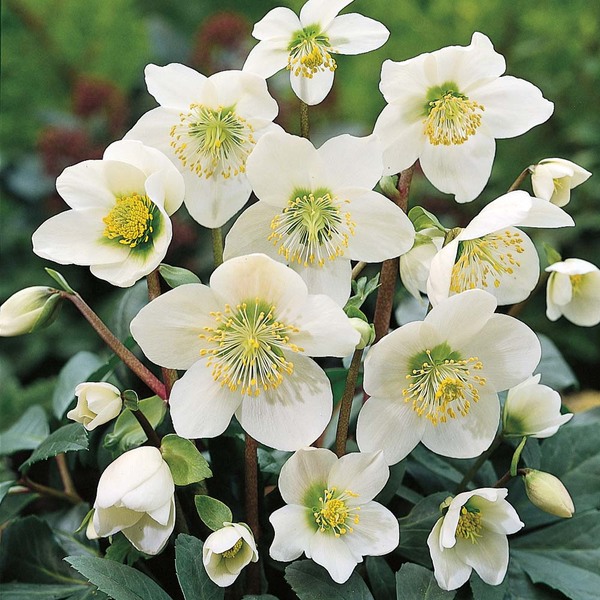
Helleborus niger
Black hellebore, Christmas rose. · Plant · Ranunculaceae
The people who benefit most from taking this remedy are characteristically dull and sluggish. It is best suited to those who feel stupefied and have slow mental processes. They commonly experience anguish, irritability, apathy, and depression. These people frequently feel as though their brains are in turmoil, and do not understand what is going on around them. Although they may beg for help, they are generally inconsolable.
Physical symptoms generally worsen between 4 p.m. and 8 p.m., and improve in warmth and when lying covered up.
Helleborus is prescribed for mental states that feature sluggishness and stupefaction. Acute inflammatory nervous conditions may be helped, as may headaches, digestive problems, and depression. Symptoms may follow as a result of concussion, surgery to the brain, or a bout of meningitis or encephalitis.
Key symptoms
- mental dullness and sluggishness
- chilliness
- tendency to drop things
- person feels worse between 4 p.m. and 8 p.m
Worse (aggravation)
- Worse from 4 to 8 pm
- Worse from cold
- Worse from mental exertion
- Worse from suppressed eruptions
- Worse from uncovering
Better (amelioration)
- Better from warmth
- Better from rest

Snow-rose (HELLEBORUS)
Produces a condition of sensorial depression. Sees, hears, tastes imperfectly, and general muscular weakness, which may go on to complete paralysis, accompanied by dropsical effusions. Hence, a remedy in low states of vitality and serious disease. Characteristic aggravation from 4 to 8 pm (Lycop). Sinking sensation. State of effusion in hydrocephalus. Mania of a melancholy type.
Mind
Slow in answering. Thoughtless; staring. Involuntary sighing. Complete unconsciousness. Picks lips and clothes.
Head
Forehead wrinkled in folds. Cold sweat. Stupefying headache. Rolls head day and night; moaning, sudden screams. Bores head into pillow; beats it with hands. Dull pain in occiput, with sensation of water swashing inside. Headache culminates in vomiting.
Eyes
Eyeballs turn upwards; squinting, vacant look. Pupils dilated. Eyes wide open, sunken. Night-blindness.
Nose
Dirty, dry nostrils. Rubs nose. Smell diminished. Nose pointed.
Face
Pale, sunken. Cold sweat. Wrinkled. Neuralgia on left side; parts so tender he cannot chew.
Mouth
Horrible smell from mouth. Lips dry and cracked. Tongue red and dry. Falling of lower jaw. Meaningless picking of lips. Grinding of teeth. Chewing motion. Greedily swallows cold water, though unconscious. Child nurses greedily, with disgust for food. Ptyalism, with sore corners of mouth.
Abdomen
Gurgling, as if bowels were full of water. Swollen, painful to touch.
Stool
Jelly-like, white mucus; involuntary.
Urine
Suppressed; scanty, dark; coffee-grounds sediment. Frequent urging. Child cannot urinate. Bladder overdistended.
Respiratory
Frequent sighing. Respiration irregular. Chest constricted; gasps for breath. Hydrothorax (Merc sulph).
Extremities
Automatic motion of one arm and leg. Limbs heavy and painful. Stretching of limbs. Thumb drawn into palm (Cupr). Vesicular eruption between fingers and toes.
Sleep
Sudden screams in sleep. Soporous sleep. Cri encephalique. Cannot be fully aroused.
Skin
Pale, dropsical, itching. Livid spots on skin. Sudden, watery, swelling of skin. Falling off of hair and nails. Angio-neurotic œdema.
Modalities
Worse, from evening until morning, from uncovering.
Relationship
(Hellebor fætidus, or, Polymnia-Bear's foot--Acts especially on spleen (Ceanothus); also rectum and sciatic nerve. Splenic pains extend to scapula, neck and head, worse left side and evening; chronic ague cake; hypertrophied uterus; glandular enlargements; hair and nails falling off; skin peeling). Hellebor orientalis (salivation).
Antidote: Camphor; Cinch.
Compare: Threatening effusion; Tuberc; Apis; Zinc; Opium; Cinch; Cicuta; Iodoform.
Dose
Tincture, to third potency.

Brain and mind
in all the complaints of Helleborus stupefaction occurs in greater or less degree. Sometimes it is a complete stupor, sometimes a partial stupor, but it is always stupefaction and sluggishness.
Hellebore is useful in affections of the brain, spinal cord, the general nervous system and mind, but especially in acute inflammatory diseases of the brain and spinal cord and their membranes, and in troubles bordering on insanity. There is a peculiar kind of imbecility or stupefaction of the body and mind.
The extreme state is unconsciousness. Complete unconsciousness in connection with cerebral congestion, or inflammation which has gone on to hydrocephalus, cerebro-spinal meningitis, or inflammation of the brain, with stupefaction.

Black Hellebore. Christmas Rose. N. O. Ranunculaceæ. Tincture of dry powdered root. Juice of fresh root mixed with equal parts of alcohol.
Clinical
Albuminuria. Amenorrhœa. Aphthæ. Apoplexy. Cholera. Concussion. Convulsions. Cystitis. Depression of spirits. Diarrhœa. Dropsy. Epilepsy. Headache. Hernia. Home-sickness. Hydrocele. Hydrocephalus. Kidneys, congestion of. Melancholia. Meningitis. Night-blindness. Puerperal convulsions. Scarlatina. Tetanus. Typhoid fever. Ulcers. Wounds.
Characteristics
Black Hellebore was one of the drugs used to produce the "Helleborism of the ancients," the subject of Hahnemann's famous essay; but the drug most commonly employed was the While Hellebore, or Veratrum album, which belongs to another family, the Melanthaceæ. "Black" hellebore receives its name from the external colour of its root; the root of Ver. alb. is extremely white. Teste quotes Hahnemann as saying: "I conclude from various observations that one of the first effects of Black Hellebore is a kind …

Christmas Rose. (Ranunculaceae.)
Weakly, delicate,, psoric children; prone to brain troubles (Bell., Cal., Tub.); with serous effusion. Melancholy: woeful; despairing; silent; with anguish; after typhoid; in girls at puberty, or when menses fail to return after appearing. Irritable, easily angered; consolation < (Ign., Nat., Sep., Sil.); does not want to be disturbed (Gels., Nat.); Unconscious; stupid; answers slowly when questioned; a picture of acute idiocy (of chronic, Bar. c.). Brain symptoms during dentition (Bell., Pod.); threatening effusion (Apis., Tub.). Meningitis: acute, cerebro-spinal, tubercular, with exudation; paralysis more or less complete; with the cri encephalique. Vacant, thoughtless staring; eyes wide open; insensible to light; pupils dilated, or alternately contracted and dilated. Soporous sleep, with screams, shrieks, starts. Hydrocephalus, post-scarlatinal or tubercular which develops rapidly (Apis, Sulph., Tub.); automatic motion of one arm and leg. Convulsions with extreme coldness of body, …

Head
Stupefied; head hot and heavy; boring into pillows; coldness of body.
Mouth and Throat
Constant chewing motion of the jaws; grinds teeth (brain troubles).
-
Stools consisting solely of clear, tenacious, colourless mucus.
-
Dropsical affections of the brain, especially after scarlatina, or summer complaint, or during dentition.
-
Constant chewing motion of the jaws, grind the teeth.
-
Loss of control of the mind over the body, must strongly concentrate the mind on what he is doing or the muscles do not act properly.

Phatak's chapter on Helleborus niger is available in the app.
Read Phatak in the appClassical texts are in the public domain. Educational reference only — not medical advice.
