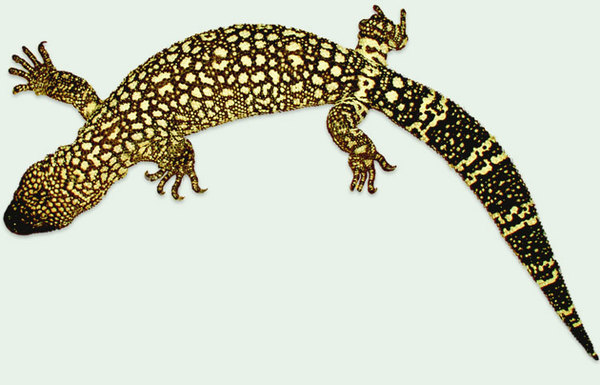
Heloderma
Heloderma suspectum (Gila monster venom) · Animal
Heloderma is a remedy characterised by profound arctic coldness pervading the entire body internally and externally. It produces a benumbing paralysis without tetanic spasm, resembling paralysis agitans or locomotor ataxia. The keynote is marked internal coldness as if frozen to death, with cyanosis of hands, staggering gait, and cold waves passing over the body.
Key symptoms
- Intense arctic coldness throughout the body
- Cold band around head; cold pressure within the skull
- Cold feeling in lungs and heart with slow laboured heartbeat
- Numbness and trembling of extremities; cyanosis of hands
- Sensation as if walking on a sponge; feet cold as ice or burning
- Staggering gait; lifts feet higher than usual, puts heel down hard
- Cold waves or rings around the body
- Tongue cold, tender, and dry; breath cold
Worse (aggravation)
- Cold applications to body
- Rest and lying still (coldness increases)
Better (amelioration)
- Stretching relieves pains in muscles and limbs

Gila Monster
The result of the bite is a benumbing paralysis like paralysis agitans or locomotor ataxia. There is no tetanic phase-a condition almost reverse in objective symptoms to Hydrocy acid or Strychnia. The most unusual action of the drug is noted upon the eye of the mouse. The eyeball becomes more prominent and the cornea opacities. The exophthalmus is due to the pressure of the blood behind the eyeball (Boyd). Homeopathically, it is indicated in many forms of disease characterized by great coldness-"arctic" coldness. Colic waves from occiput to feet or ascending.
Head
Very depressed. Sensation as if would fall to right side. Cold band around head; cold pressure within the skull. Eyelids heavy. Pain beginning in right ear, extending round back of head to left ear.
Face
Cold crawling feeling, as if facial muscles were tight.
Mouth
Tongue cold, tender, and dry. Very thirsty. Swallowing difficult. Breath cold.
Chest
Cold feeling in lungs and in heart. Slow labored thumping of heart.
Back
Coldness across scapulæ. Burning along spine.
Extremities
Numbness and trembling. Cyanosis of hands. Coldness. Sensation as if walking on sponge, and as if feet were swollen. Staggering gait. Cock's gait. When walking, lifts feet higher than usual, and puts down heel hard. Feet cold as ice or burn. Stretching relieves pains in muscles and limbs.
Fever
Internal coldness, as if frozen to death. Cold rings around body. Cold waves (Abies c; Acon). Cold spots. Arctic coldness. Temperature subnormal-96° (Camph).
Relationship
Compare: Lacerta-Green Lizard (skin eruptions. Vesicles under tongue. Increased mental acumen. Difficult swallowing. Constant accumulation of saliva in the mouth. Nausea; violent pressure in stomach). Camphor; Lachesis.
Dose
Thirtieth potency.

Gila monster. Heloderma suspectum. N. O. Helodermidæ of the Lacertilia. Trituration of sugar of milk saturated with the venom. Solution of the venom in alcohol.
Clinical
Brain, base of, affected. Cerebro-spinal meningitis. Coldness. Headache. Heart failure. Locomotor ataxy. Neuralgia. Numbness. Paralysis. Paralysis agitans.
Characteristics
The information we possess of the action of Heloderma is contained in vols. v. to xi. of Hom. Recorder, including some remarkable and important provings by Dr. R. Boocock. The name given to this remedy by the Recorder is Heloderma horridum, but as there is no little confusion between two species, I prefer to name the remedy Heloderma simply. The first notice of the remedy is in vol. v. p. 163, in letters from Dr. Charles D. Belden, who supplied Messrs. Boericke and Tafel with a living specimen and also poison obtained by himself. Dr. Belden calls his specimens "H. horridum OR Suspectum." Now Dr. Belden writes from Arizona, and the river Gila (pronounced "Hecla") …
Classical texts are in the public domain. Educational reference only — not medical advice.
