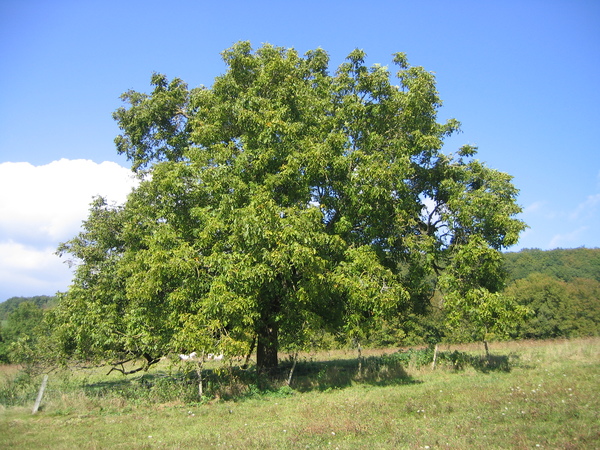
Juglans regia
Plant · Juglandaceae
Juglans regia is primarily a skin remedy, acting on the sebaceous glands and lymphatic system to produce acne, comedones, and suppurative eruptions. The constitutional type tends toward sluggish lymphatic circulation with tendency to glandular suppuration and offensive skin conditions. It has an affinity for the head, skin, and female reproductive system.
Key symptoms
- Skin eruptions prominent: acne, comedones, pustules
- Occipital sharp pain with sensation of floating head
- Styes on eyelids
- Scalp red and itches violently at night
- Crusta lactea with soreness around ears
- Axillary glands suppurate
- Menses early, black, pitch-like coagula
- Head feels as if floating in air
Worse (aggravation)
- Night (scalp itching)

Walnut
Skin eruptions are prominent.
Head
Confused; feels as if head were floating in air. Occipital sharp pain. Styes.
Female
Menses early, black, pitch-like coagula. Abdomen distended.
Skin
Comedones and acne of the face. Crusta lactea, with soreness around ears. Itching and eruptions of small red pustules. Scalp red, and itches violently at night. Chancre-like ulcer. Axillary glands suppurate.
Relationship
Compare: Juglans cinerea.
Dose
Tincture, and lower potencies.

Nux juglans. Walnut. Juglandaceæ. Tincture of leaves and of rind of green fruit.
Clinical
Acne. Anus, burning in. Axillary glands, suppuration of. Chancre. Ecthyma. Eyes, pain over. Favus. Flatulence. Headache. Herpes. Herpes preputialis. Levitation, sensation of. Menorrhagia. Purpura. Ringworm. Scurvy. Spleen, pain in. Syphilis.
Characteristics
"It was said that in the golden age, when men lived upon acorns, the gods lived upon Walnuts, and hence the name of juglans, Jovis glans, or Jupiter's nuts" (Treasury of Botany). From many points of view the walnut-tree is of very great importance, and well deserves its lofty name. Besides providing food, at any rate fit for the gods, and wood at once light and strong, a sap that yields sugar, a fruit that yields a dye and an oil, and serves for pickles, the Royal Nut has a place in medicine which deserves to be better known. The Treasury of Botany gives a hint to homœopaths in this remark: "Its plantation should not be too near dwellings, as some persons are …
Classical texts are in the public domain. Educational reference only — not medical advice.
