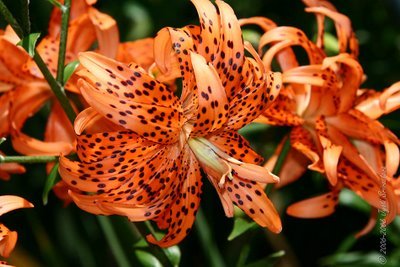
Lilium tigrinum
Lilium lancifolium (syn. L. tigrinum) · Tiger lily,Lilium lancifolium · Plant · Liliaceae
Lilium is traditionally linked with people who are hurried and impatient, and generally trying to do too many things at once. They often feel wild and out of control, and may even fear that they are going insane. They like to be the center of attention and can be quick to anger if they are not. Alternatively, they may be filled with feelings of remorse, especially of a religious nature, and torment themselves endlessly about their behavior.
A conflict between very high moral standards and intense sexual urges is characteristic in these people. The suppression of their sexual desire generally aggravates frustration and anger. They are often sensitive to criticism, easily offended, irritated, even by kindness, and hurried beyond reason. People who respond well to this remedy typically have a burning sensation in their hands, and prefer cool weather.
Lilium is prescribed chiefly for female reproductive-system disorders. It is also given for states of despair and depression, and for urinary complaints, angina, and poor circulation.
Key symptoms
- hurry and impatience
- intense sexual urges
- preference for cool, fresh air
- sensation as though the heart is being gripped
Worse (aggravation)
- Standing
- Warm room
- Being consoled
- Left side
- Pressure downward from pelvic organs
Better (amelioration)
- Walking in open air
- Keeping busy
- Cool air

Tiger-lily
Manifests powerful influence over the pelvic organs, and is adapted to many reflex states dependent on some pathological condition of uterus and ovaries. More often indicated in unmarried women. The action of the heart is very marked. Pain in small spots (Oxal ac). Rheumatic arthritis.
Mind
Tormented about her salvation. Consolation aggravates. Profound depression of spirits. Constant inclination to weep. Anxious; fears some organic and incurable disease. Disposed to curse, strike, think obscene things. Aimless, hurried manner; must keep busy.
Head
Hot, dull, heavy. Faint in warm room. Wild feeling in head.
Eyes
Hyperæsthesia of retina. Pain, extending back into head; lachrymation; and impaired vision. Myopic astigmia. Useful in restoring power to the weakened ciliary muscle (Arg nit).
Stomach
Flatulent; nausea, with sensation of lump in stomach. Hungry; longs for meat. Thirsty, drinks often and much, and before severe symptoms.
Abdomen
Abdomen sore, distended; trembling sensation in abdomen. Pressure downwards and backwards against rectum and anus; worse, standing; better, walking in open air. Bearing down in lower part of abdomen.
Urinary
Frequent urging. Urine milky, scanty, hot.
Stool
Constant desire to defecate, from pressure in rectum, worse standing. Pressure down the anus. Early-morning urgent stool. Dysentery; mucus and blood, with tenesmus, especially in plethoric and nervous women at change of life.
Heart
Sensation as if heart were grasped in a vise (Cact). Feels full to bursting. Pulsations over whole body. Palpitation; irregular pulse; very rapid. Pain in cardiac region, with feeling of a load on chest. Cold feeling about heart. Suffocating feeling in a crowded and warm room. Angina pectoris with pain in right arm.
Female
Menses early, scanty, dark, clotted, offensive; flow only when moving about. Bearing down sensation with urgent desire for stool, as though all organs would escape. Ceases when resting (Sep; Lac c; Bell). Congestion of uterus, prolapse, and anteversion. Constant desire to support parts externally. Pain in ovaries and down thighs. Acrid, brown leucorrhœa; smarting in labia. Sexual instinct awakened. Bloated feeling in uterine region. Sub-involution. Pruritus pudendi.
Extremities
Cannot walk on uneven ground. Pain in back and spine, with trembling, but oftener in front of a pressing-down character. Pricking in fingers. Pain in right arm and hip. Legs ache; cannot keep them still. Pain in ankle joint. Burning palms and soles.
Sleep
Unrefreshing, with disagreeable dreams. Unable to sleep, with wild feeling in head.
Fever
Great heat and lassitude in afternoon, with throbbing throughout body.
Modalities
Worse consolation, warm room. Better, fresh air.
Relationship
Compare: Cact; Helon; Murex; Sep; Plat; Pallad.
Antidote: Helon.
Dose
The middle and higher potencies seem to have done best. Its curative action sometimes is slow in developing itself.

So far as proved Lilium Tigrinum has shown itself adapted to the complaints of women.
It is especially suited to hysterical women, who suffer from uterine troubles, cardiac troubles and various nervous manifestations; suitable to a woman who is extremely irritable, full of fanciful notions, insanity, religious melancholy and imaginations, with cardiac affections and prolapsus.
These conditions often alternate; when the mental symptoms are most marked the physical symptoms are relieved. The "dragging down" that is associated with prolapsus seems to be a dragging down from the region of the stomach, and even sometimes from the throat.
A bearing down, as if all the interior organs were dragging down. With this state of extreme relaxation there is great fidgetiness and most marked of all, palpitation. She can lie only on the back, and is aggravated from lying on either side. From every emotion the heart flutters, and is irregular and excitable. These mental symptoms and heart symptoms and uterine symptoms often rotate or alternate, and constitute the principal features.

Tiger Lily. N. O. Liliaceæ. Tincture of fresh stalk, leaves, and flowers. (Some of the provings were made with tincture of the pollen alone.)
Clinical
Angina pectoris. Asthenopia. Astigmatism. Dementia. Diarrhœa. Dysentery. Eyes, affections of. Fibroma. Heart, affections of; Palpitation of. Hysteria. Ovaries, affections of; dropsy of. Pruritus vulvæ. Spinal irritation. Urination, too frequent. Uterus, affections of; displacements of; subinvolution of.
Characteristics
The Tiger Lily, which was introduced into the West from China and Japan, was first suggested as a remedy by W. E. Payne. Carroll Dunham urged Payne to have it well proved. This Payne did, and Dunham himself assisted by having it proved on a woman under his own supervision. The account of this case of Lilium tigrinum disease, with others, is given in Dunham's lucid style in his Science of Therapeutics. Lil. t. was given in the 30th and 3rd attenuations, which were taken during ten days. The symptoms began early but were somewhat slow in …

Tiger Lily. (Liliaceae.)
Affects principally the left side of the body (Lach., Thuja). Tormented about her salvation (Lyc., Sulph., Ver.), with ovarian or uterine complaints; consolation <. Wild, crazy feeling on vertex; confused ideas. Profound depression of spirits; can hardly avoid weeping; is very timid, fearful and weeps much; indifferent about what is being done for her. Anxious: about the disease; fears the symptoms indicate an organic affection; marked in both sexes. Disposed to curse, strike, to think obscene things (Anac., Lac c.); alternates with uterine irritation. Listless, yet cannot sit still; restless, yet does not want to walk; must keep busy to repress sexual desire. Desire to do something, hurried manner, yet has no ambition; aimless, hurried motion (Arg. n.). Fears: being alone, insanity, heart disease; fears she is incurable; some impending calamity or disease. Headaches and mental ailments depending on uterine irritation or displacement. Menstrual irregularities and irritable heart. Cannot …

Mind
Constant hurried feeling, as if of imperative duties, and utter inability to perform them.
Urinary Organs
Continual pressure upon the bladder, wants to urinate all the time (uterine displacements).
Female Sexual Organs
Menses flow only when moving about, ceases when she ceases to walk.
Female Sexual Organs
Great bearing down in the uterine region, with a sensation when on the feet as though the contents of the pelvis would issue from the vagina if not prevented by pressure with the hand against the vulva, or sitting down.
Heart and Pulse
Feeling as if the heart contained too much blood, which might me > by throwing it up.
Heart and Pulse
Heart feels as if squeezed in a vise, or alternately grasped and relaxed.
-
Constant hurried feeling as of imperative duties, and utter inability to perform them.
-
Bearing down, with a sensation of a heavy weight and pressure in uterine region, as if the whole contents would press out through the vagina; relieved by pressure of hand against vulva.
-
Dull, pressive pain in region of heart, or sharp, quick pain with fluttering of the heart.
-
Heart feels as if squeezed in a vice, or alternately grasped and relaxed.
-
Nervous affections of the heart dependent upon, uterine and ovarian diseases.

Phatak's chapter on Lilium tigrinum is available in the app.
Read Phatak in the appClassical texts are in the public domain. Educational reference only — not medical advice.
