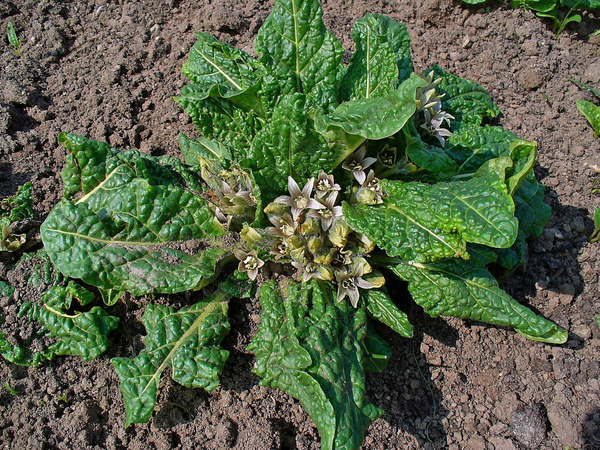
Mandragora
Mandragora officinarum · Common mandrake, devil’s apple,Mandragora officinarum · Plant · Solanaceae
People for whom Mandragora is best suited are prone to changeable moods, such as crying spells alternating with feelings of euphoria. They may be in a state of “aroused exhaustion,” simultaneously sleepy and hyperactive. They are hypersensitive, particularly to noise, but also to smell; symptoms are violent in nature.
The classic symptom profile associated with Mandragora focuses on abdominal pain that is worse on the upper right side and better for bending backward. The remedy may also help limbs that feel heavy, bruised, and sore, as if from muscular exertion, and may ease sciatica with burning pain that is worse on the right side. A further use is for congestive headaches that are better for cold air and cold compresses.
Key symptoms
- Restless excitability with bodily weariness
- Great desire for sleep
- Inactive bowels with white, hard stools
- Exaggeration of sounds and enlarged vision
- Unpleasant symptoms go off at night in bed with gentle perspiration
Worse (aggravation)
Better (amelioration)

Mandragora officinarum. Atropa mandragora. Mandrake. N. O. Solanaceæ. Tincture of plant without the root.
Clinical
Constipation.
Characteristics
The mandrake does not derive its name from the shape of the human body which the root of the plant sometimes takes, but from the name by which it was known to the Greeks, Mandragora, and which signifies injurious to cattle. In legend and poetry the mandrake figures largely. It is said to be the "Insane root" spoken of by Macbeth, and it is mentioned by name in Antony and Cleopatra and Romeo and Juliet. Mand. must not be confounded with Podophyllum, which is also sometimes called "Mandrake," as also is Bryonia dioica in this country. Mand. is known to homœopathy through some experiments of Dufresne made on himself and another by repeatedly smelling, at short intervals, the expressed juice of the plant, "which has a nauseating odour like adder's flesh"; and also by an experiment of W. B. Richardson's. There are two varieties of Mand. offic., the vernal and …
Classical texts are in the public domain. Educational reference only — not medical advice.
