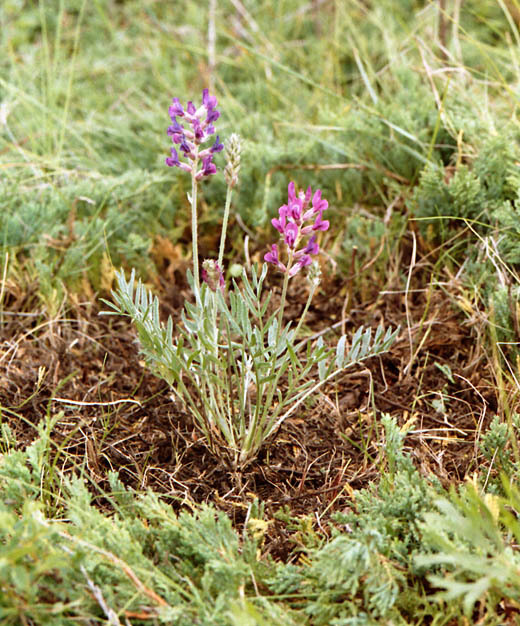
Oxytropis lamberti
Plant · Fabaceae
Oxytropis lamberti suits patients with profound nervous system involvement including spinal congestion, paralysis, and loss of reflexes. It is indicated when there is staggering gait, incoordination, relaxed sphincters, and mental depression with desire to be alone and disinclination to work or talk.
Key symptoms
- Staggering gait with loss of coordination
- Trembling and sensation of emptiness
- Walks backwards
- Sphincters relaxed; stools slip from anus like lumps of jelly
- Patellar tendon reflex lost
- Mental depression; desires to be alone; disinclined to work or talk
- Sight obscured; pupils contracted and unresponsive to light
- Pains come and go quickly but muscles remain sore and stiff
- Numb feeling about spine
Worse (aggravation)
- Worse from thinking of symptoms

Loco-weed (OXYTROPIS)
Marked action on nervous system. Trembling, sensation of emptiness. Walks backwards. Congestion of spine and paralysis. Pains come and go quickly. Sphincters relaxed. Staggering gait. Reflexes lost.
Mind
Desires to be alone. Disinclined to work or talk. Worse, thinking of symptoms (Oxalic ac). Mental depression. Vertigo (Granatum).
Head
Vertigo. Full, warm feeling about head. Feeling of intoxication, with loss of vision. Pain in maxillary bones and masseter muscles. Mouth and nose dry.
Eyes
Sight obscured; pupils contracted; do not respond to light. Paralysis of nerves and muscles of eyes.
Stomach
Eructations with colicky pains. Epigastrium tender.
Rectum
Sphincter seems relaxed. Stools slip from anus, like lumps of jelly, mushy.
Urine
Urging to urinate when thinking of it. Profuse flow. Pain in kidneys (Berberis).
Male
No desire or ability. Pain in testicles and along spermatic cord and down thighs.
Extremities
Pain along ulnar nerve. Numb feeling about spine. Staggering gait. Loss of co-ordination. Patellar tendon reflex lost. Pains come and go quickly, but muscles remain sore and stiff.
Sleep
Restless, dreams of quarrel.
Modalities
Worse, thinking of symptoms (mono-maniac tendency). Worse, every other day. Better, after sleep.
Relationship
Compare: Astrag; Lathyr; Oxal ac; Baryta (Loco plant is rich in Baryta). Lolium.
Dose
Third potency and higher.

Oxytropis Lamberti (Pursh). (Including O. Campestris, Hook.) "Loco" Weed. Rattle-weed. N. O. Leguminosæ. Tincture of fresh plant (without root).
Clinical
Amblyopia. Bladder, irritability of. Cough. Fever. Impotence. Locomotor ataxy. Ovary, pain in. Paralysis. Rheumatism. Spermatic cord, pain in. Sphincters, relaxation of. Testicles, pain in. Vertigo.
Characteristics
The "Loco-weed" or "Crazy-weed" ("loco" is of Spanish origin, and means "crazy") has been variously identified by Gray as Astragalus legum, by others as Astragalus mollissimus, and by W. S. Gee, who made the proving, as Oxytropis Lamberti (M. A., xvii. 441). Probably the writer of the botanical articles in the Century Dictionary is nearest the mark in saying that Loco-weed is "any one of several leguminous plants producing the loco-disease in animals. Among them are Astragalus mollissimus and A. Hornii, with several other species of the genus, and Oxytropis Lamberti." Henfry's Botany remarks that the foliage of "O. Lamberti is said …

Phatak's chapter on Oxytropis lamberti is available in the app.
Read Phatak in the appClassical texts are in the public domain. Educational reference only — not medical advice.
