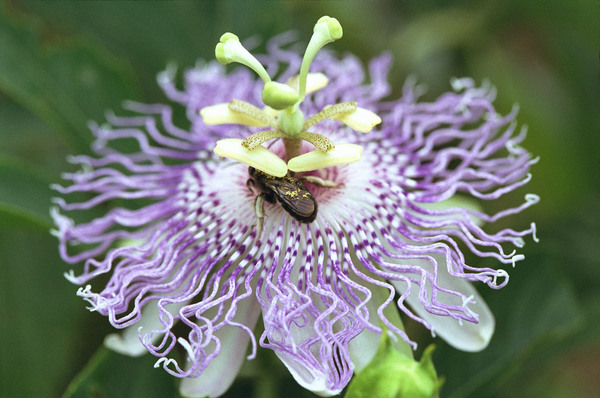
Passiflora incarnata
Passion flower. · Plant · Passifloraceae
The classic symptom linked with Passiflora is insomnia. Those who respond best to the remedy tend to lie awake at night and become exhausted. They are prone to odd sensations; they may feel that their eyeballs are protruding, as if being pushed out of their heads, or that the tops of their heads are lifting off. On lying down they may feel that their heels are rising up in the air. Passiflora is considered particularly effective for alcoholics and screaming children.
The remedy may also help whooping cough that is worse at night, and insomnia accompanied by hemorrhoids, pain in the coccyx, or discomfort during or just before menstruation.
Key symptoms
- An efficient anti-spasmodic.
- Violent ache as if top of head would come off-eyes felt as if pushed out.
- Leaden, dead feeling after or between meals; flatulence and sour eructations.
- Restless and wakeful, resulting from exhaustion.
- Especially in the feeble, infants and the aged.
Worse (aggravation)
Better (amelioration)

Passion-flower
An efficient anti-spasmodic. Whooping-cough. Morphine habit. Delirium tremens. Convulsions in children; neuralgia. Has a quieting effect on the nervous system. Insomnia, produces normal sleep, no disturbance of cerebral functions, neuroses of children, worm-fever, teething, spasms. Tetanus. Hysteria; puerperal convulsions. Painful diarrhœa. Acute mania. Atonic condition generally present. Asthma, 10-30 gtt every ten minutes for a few doses. Locally, in erysipelas.
Head
Violent ache as if top of head would come off-eyes felt as if pushed out.
Stomach
Leaden, dead feeling after or between meals; flatulence and sour eructations.
Sleep
Restless and wakeful, resulting from exhaustion. Especially in the feeble, infants and the aged. Insomnia of infants and the aged, and the mentally worried, and overworked, with tendency to convulsions. Nocturnal cough.
Dose
Large doses of mother tincture are required-thirty to sixty drops, repeated several times.

Passiflora incarnata. Passion Flower. N. O. Passifloraceæ (of the Violal alliance). Tincture of fresh or dried leaves gathered in May. Fluid hydro-alcoholic extract. Powdered inspissated juice.
Clinical
Burns. Cholera infantum. Convulsions. Delirium tremens. Dentition. Epilepsy. Erysipelas. Exophthalmos. Levitation. Sciatica. Sleeplessness. Tetanus; neonatorum.
Characteristics
Passiflora has not been proved. Its curative action appears to be of a direct kind. Hale introduced it to homœopathy, citing in the New Remedies a paper by L. Phares. Phares learned its action from W. B. Lindsay, who used it with extraordinary success in tetanus of the newborn. An aqueous extract of the root Lindsay commended as an application for chancre, erysipelas, irritable piles, and new burns. Phares confirms the efficacy of Passif. in erysipelas (he "never saw anything act so promptly"), ulcers, neuralgia, and tetanus. He cites the case of an old lady who was seized with convulsions of a tetanic nature, and refers to several …

Phatak's chapter on Passiflora incarnata is available in the app.
Read Phatak in the appClassical texts are in the public domain. Educational reference only — not medical advice.
