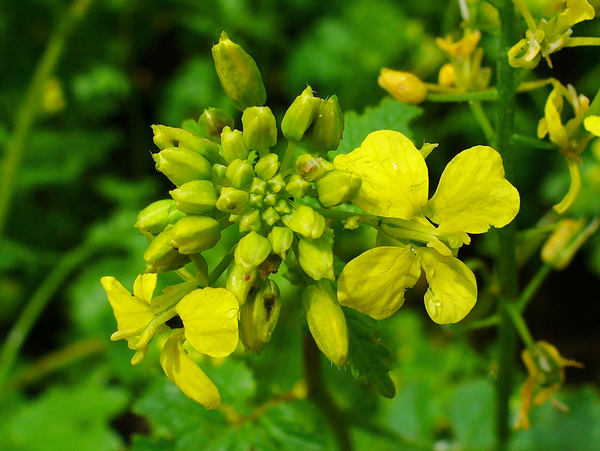
Sinapis alba
Plant · Brassicaceae
Sin. alb., like Sin. nig., is indigenous in Great Britain. Its seeds are larger than those of Black Mustard, and of a yellow colour externally. Chemically they differ in containing a crystalline substance known as sulpho-sinapism. The seed-leaves or cotyledons of Sin. alb. furnish the "mustard" of the table.
Key symptoms
- Anus itching and affections
- Flatulence
- Gastric ulcer
- Gastritis
- Headache
- Heartburn
- Lactation dyspepsia
- Mouth inflammation and ulceration
- Salivation
- Worms

Brassica alba. White Mustard. Senf-Kohl. N. O. Cruciferæ. Trituration and tincture of the seeds.
Clinical
Anus, itching of; affections of. Flatulence. Gastric ulcer. Gastritis. Headache. Heartburn. Lactation, dyspepsia of; sore mouth of. Mouth, inflammation of; ulceration of. Œsophagus. Pregnancy, dyspepsia of; sore mouth of. Salivation. Threadworms. Vomiting. Worms.
Characteristics
Sin. alb., like Sin. nig., is indigenous in Great Britain. "Its seeds are larger than those of Black Mustard, and of a yellow colour externally. Chemically they differ in containing a crystalline substance known as sulpho-sinapism. Moreover, its myrosine yields with water a pungent oil of a different character from the Volatile Oil of Mustard" obtained from Sin. nig. (Treas. of Bot.). The seed-leaves or cotyledons of Sin. alb. furnish the "mustard" of "mustard and cress "─the "cress" being Lepidium sativum. Bojanus proved Sin. alb., taking substantial doses of the triturated seeds and of a tincture made therefrom. The …
Classical texts are in the public domain. Educational reference only — not medical advice.
